The Importance of National Breastfeeding Month
-
 By
Alyssa McPherson
By
Alyssa McPherson
- Jun 30, 2026

Every August, we recognize National Breastfeeding Month—a time to celebrate breastfeeding as the gold standard of infant nutrition and strengthen the education, encouragement, and community support that helps mothers and babies thrive.
This nationwide public health awareness campaign brings together healthcare organizations, lactation professionals, policymakers, advocacy groups, and families to advance breastfeeding access and care. It's led by the United States Breastfeeding Committee, whose 2026 theme—RISE: resilience, interdependence, self-determination, empowerment—reflects something many families already know: breastfeeding is not meant to be done alone.
As an International Board Certified Lactation Consultant, I’ve seen firsthand how feeding journeys are shaped by far more than individual effort. They are influenced by a mother's support system, her workplace, and the environment where she gives birth and recovers. Individual effort matters, but it's rarely the whole story.
Why National Breastfeeding Month Matters
Breastfeeding Recommendations
When we look at global guidance on infant feeding, two leading health authorities—the World Health Organization and the American Academy of Pediatrics—are aligned in their recommendations.
Both recommend exclusive breastfeeding for about the first six months of life, followed by continued breastfeeding alongside appropriate complementary foods for up to 2 years or beyond, as long as desired by mom and baby. These recommendations reflect the important role of breast milk in early development and in supporting families as they work toward their feeding goals.
During National Breastfeeding Month, these recommendations also serve as an important reminder: meeting breastfeeding goals can be hard, and often requires more than education alone. Access to lactation care, community resources, and sustainable support systems can all influence how confident new mothers feel throughout their feeding journey.
Health Benefits for Babies
Breast milk offers babies more than nutrition. It helps meet their evolving needs as they grow—and its benefits continue for as long as your baby is nursing.
It can help support:
-
Their developing gut microbiome, which plays a role in digestion and immune health
-
Lower risk of ear infections, respiratory infections, and gastrointestinal illness
-
Healthy growth during a critical period of rapid brain and physical development
Health Benefits for Mothers
Breastfeeding is associated with a range of short- and long-term maternal health benefits, including:
-
Reduced risk of postpartum hemorrhage
-
Delayed return of ovulation and menstruation, especially with exclusive breastfeeding
-
Lower rates of breast and ovarian cancer
-
Reduced risk of type 2 diabetes
-
Lower risk of high blood pressure and cardiovascular disease later in life
It’s also worth remembering that breastfeeding is a learned skill. The early weeks are a period of adjustment for both mom and baby—and reassurance during this time can make a real difference. In my work as a lactation consultant, I've often seen how timely education and support in those first days and weeks can help mothers feel more confident, ease early challenges, and protect long-term feeding goals. Having someone in your corner can make the difference between pushing through and giving up before you are ready.
Additional Benefits of Breastfeeding
For many families, breastfeeding also offers practical benefits that extend beyond nutrition and health.
From a financial perspective, breastfeeding can reduce the ongoing cost of feeding supplies—including formula, bottles, and accessories—as well as the time and energy spent purchasing, preparing, and sanitizing bottles. Over time, these savings can ease some of the financial demands that come with feeding a new baby.
Breastfeeding also has a lower environmental impact than formula feeding, reducing the need for manufacturing, packaging, transportation, and the waste associated with feeding supplies and single-use materials. And for day-to-day life, many mothers find it simply more flexible. There's no measuring, mixing, or preparation—which matters at 3 a.m. or when families are on the go.
It can also offer peace of mind in unexpected situations, such as power outages, travel delays, or times when access to supplies may be limited. Because your milk is always readily available, many mothers describe a greater sense of reassurance and ease in their daily lives.
World Breastfeeding Week
National Breastfeeding Month begins with World Breastfeeding Week, led by the World Alliance for Breastfeeding Action. This year’s theme—Breastfeeding: A Sustainable Start, Strengthened by Support—captures something we see clearly in lactation care every day: breastfeeding outcomes are shaped by the systems around mothers.
Feeding is often described as an individual journey, but it is deeply influenced by healthcare access, workplace policies, family encouragement, and community-based care. When those supports are in place, mothers are more likely to meet their goals with confidence and less stress. This is why lactation care is increasingly recognized as preventive care—not just something to seek when challenges arise, but something that can help prevent challenges from escalating in the first place.
National Breastfeeding Month is also supported through online awareness campaigns that help connect families, healthcare professionals, and advocacy organizations. Throughout August, social media conversations often use hashtags such as #NationalBreastfeedingMonth, #WorldBreastfeedingWeek, #BreastfeedingSupport, and #NormalizeBreastfeeding to share education, resources, and personal experiences.
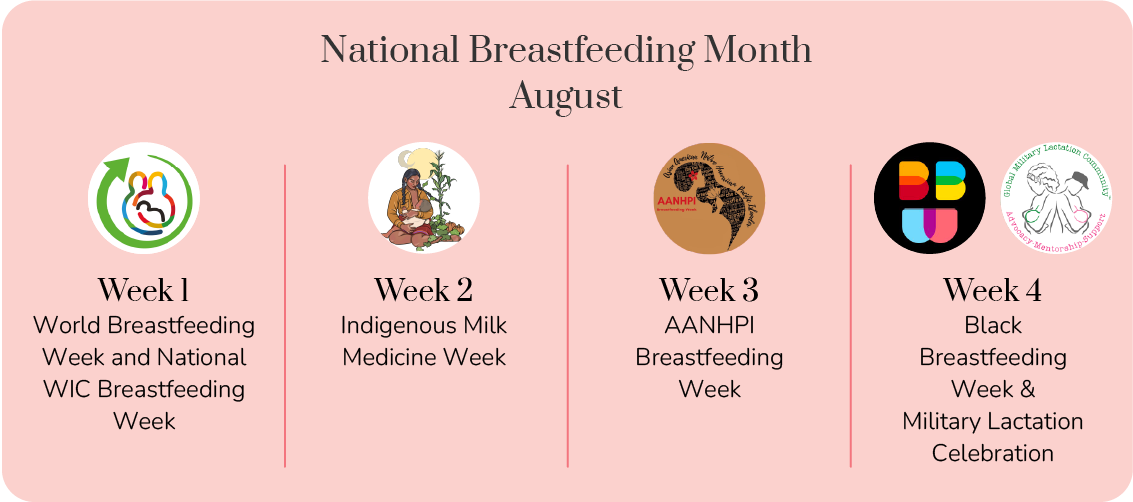
Throughout the rest of August, National Breastfeeding Month expands on these themes through a series of observances that highlight the many communities, cultures, and support systems that help mothers meet their feeding goals. Together, these celebrations remind us that while every breastfeeding journey is unique, no mother should have to navigate it alone.
Breastfeeding Observances Throughout August
Throughout National Breastfeeding Month, each week in August highlights different communities, experiences, and systems of care—reflecting the many ways breastfeeding journeys are shaped by culture, identity, access, and support.
National WIC Breastfeeding Week
During the first week of August, National WIC Breastfeeding Week highlights the important role public health programs play in supporting breastfeeding families. As the United States federal supplemental nutrition program, WIC (Women, Infants, and Children) was designed with maternal and infant health at its core.
By connecting families with nutrition support, breastfeeding education, and trained peer counselors, it helps address some of the health disparities that can emerge in the earliest weeks of a baby's life. For many mothers, this type of community-based support can make breastfeeding and pumping feel more approachable and less isolating. Talking to someone who understands the early challenges of feeding can help build confidence and make this time more manageable.
Indigenous Milk Medicine Week
The second week of August recognizes Indigenous Milk Medicine Week, led by the Indigenous Milk Medicine Collective. This observance centers Indigenous knowledge and the cultural significance of breastfeeding within Indigenous communities.
Indigenous milk medicine reflects traditional teachings that have supported families for generations, reminding us that breastfeeding is not only about nutrition, but also about culture, relationships, and identity. Honoring these traditions means respecting culturally grounded care and supporting approaches to feeding that reflect community values and intergenerational knowledge.
AANHPI Breastfeeding Week
The third week of August recognizes Asian American Native Hawaiian and Pacific Islander (AANHPI) Breastfeeding Week, led by organizations including the AANHPI Lactation Collaborative. AANHPI communities span a wide range of diverse cultures, languages, and traditions—and this week highlights the importance of lactation support that is both culturally responsive and accessible in families’ preferred languages.
When care reflects both cultural context and language needs, mothers are better able to ask questions, understand guidance, and develop confidence in their feeding journey.
Black Breastfeeding Week
The fourth week of August is Black Breastfeeding Week—a time to center and uplift the experiences of Black women and breastfeeding families. This week also celebrates the strength of community advocacy and the importance of creating spaces where Black mothers feel heard, respected, and supported in their feeding goals.
It also reflects a broader truth: when families have equitable access to education, care, and community support, breastfeeding can be more sustainable and empowering over time.
Military Lactation Celebration
Also during the fourth week, Military Lactation Celebration recognizes the unique experiences of military families balancing service with breastfeeding and pumping.
This often requires flexibility and reliable accommodations, including access to lactation spaces, protected time and privacy to pump, and ongoing support through training, field work, and deployment. These supports can make a significant impact in helping military mothers continue breastfeeding while meeting the demands of military life.
Continued advocacy for military lactation protections helps ensure that more service members can meet their feeding goals while honoring their responsibilities.
Supporting Breastfeeding Beyond August
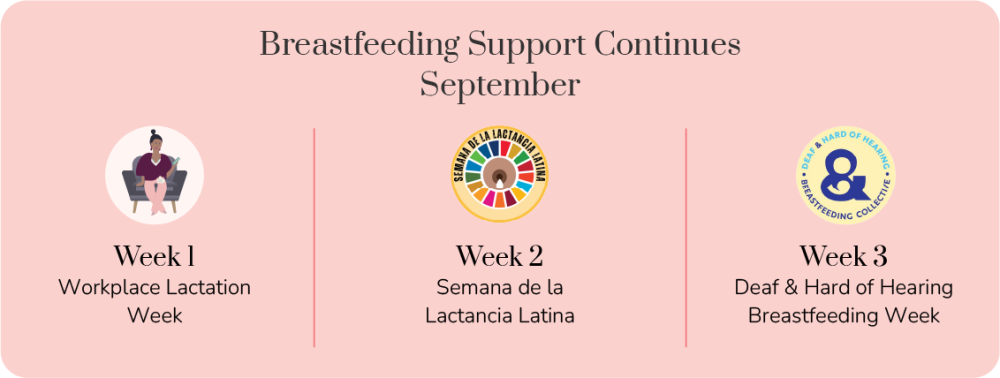
The conversation around breastfeeding support doesn't end in August. Several important observances extend into September, highlighting how feeding journeys are shaped not only by early education, but by workplace policies, cultural awareness, and inclusive care over time.
Workplace Lactation Week
Observed during the first week of September around Labor Day, Workplace Lactation Week highlights the importance of workplace accommodations for nursing and pumping mothers.
Returning to work is a major transition, and supportive workplace policies can make a real difference in whether moms continue breastfeeding after maternity leave. As an IBCLC, I often work with mothers navigating the transition back to work. Access to clean, private spaces and flexible time to pump enable mothers to balance their long-term feeding goals with their professional responsibilities.
Semana de la Lactancia Latina
Observed during National Hispanic Heritage Month, Semana de la Lactancia Latina honors the experiences, cultural identity, and voices of Latina mothers and families.
In many Latin cultures, breastfeeding is woven into family life—shaped by traditions that emphasize closeness, nurturing, and shared caregiving across generations. Access to lactation care that respects both language and culture can help families feel understood and supported in healthcare settings, breastfeeding education, and support.
Deaf & Hard of Hearing Breastfeeding Week
The third week of September recognizes deaf and hard of hearing mothers and highlights the importance of accessible communication, inclusive education, and equitable support for all mothers.
This includes ensuring that lactation support is clearly communicated and available in formats that meet different communication needs. Every mother deserves access to breastfeeding education and support that is respectful, understandable, and truly accessible—so she can feel confident on her journey.
Where Can Breastfeeding Mothers Find Support?
No matter where you are on your feeding journey, help is available—and it often makes a noticeable difference in both confidence and outcomes.
You can reach out to:
-
Your healthcare provider
-
An Aeroflow Breastpumps class or one-on-one appointment with one of our lactation consultants
-
A local or online breastfeeding support group, including our Facebook Group The Pumping Room
Breastfeeding can look different for every mother. There is no single path that works for everyone. What remains true is that support matters—and it can change how feedings feel day to day, and how they evolve over time.
Whether you are just getting started, working through a challenge, returning to work, or continuing a long-term breastfeeding journey, there are resources, guidance, and communities available to help along the way. You don't have to figure it out alone.
Final Thoughts on National Breastfeeding Month
National Breastfeeding Month is a reminder that we all can do more than simply encourage breastfeeding. Mothers deserve real access to care, community, and the systems that help them meet their goals.
That support can come from a healthcare provider, a lactation consultant, a peer support group, or another mother who has been there before. However it arrives, no one should have to navigate their feeding journey alone. Because when mothers are supported, mothers and babies thrive—and families and communities are stronger for it.